Friday, 16 March 2012

You Are Entitled …. to IBM Software

One of my colleagues pointed out that the IBM "You Are Entitled!" workshops are coming to Manchester, Edinburgh and London later this month: -

Wouldn't it be great if we were entitled to more with our investments? Find out about what additional software you may be entitled to as part of your existing IBM Collaboration Solutions license subscription, and delve into the latest and greatest version of IBM Lotus Notes/Domino, IBM Connections and IBM Portal.


Hope to see you there.

IBM Web Experience Factory - Always More To Look At … And a new version :-)

A useful set of resources, including: -


New features and enhancement in this release include:

• Support for the latest IBM WebSphere Portal Beta
• Support for a client-side mobile web UI architecture, for performance and scalability benefits - see link below for more details on this feature
• Automated support for Dojo Mobile, for an enhanced user experience on mobile devices
• Enhancements to the Web Experience Factory Designer IDE and developer tools, for improved productivity
• Support for the latest IBM software, to ensure simplified deployment and compatibility
• CMIS (Content Management Interoperability Services) builder, for integration with content management systems such as Filenet and Sharepoint 2010


The attachment below contains samples files for use with a lab on creating mobile/multi-channel web applications with Web Experience Factory.


IBM® Web Experience Factory (formerly WebSphere® Portlet Factory) is a powerful and flexible development tool that allows developers to rapidly build, customize, and deploy portlets to IBM WebSphere Portal. As a user navigates across various portal pages, WebSphere Portal server maintains the current state of the Web Experience Factory portlets and caches their view state.

Returning users might come to a previously visited page, either using portal page navigation from the theme or through wiring, links from other portlets, or through some other navigation mechanism. When users return to a previously visited page, they are presented with a cached view of the portlet.

Each portlet's state is independently maintained by WebSphere Portal so that, when a user navigates away from a portal page and then later returns, the portlet's state is persisted across page views. This is the default WebSphere Portal and Web Experience Factory behavior, and the cached view for the various portlets is cleared only when the user logs out and logs back in. 

In some cases, however, a portlet project may present the developer with a requirement to consistently display a Web Experience Factory portlet, using a page view that reflects a portlet's initial visual state. For these use cases, it is desirable to override the default WebSphere Portal and Web Experience Factory behavior by displaying portlet page views that ignore the portlet's cached state.

This article explains the detailed steps to achieve this scenario in a Web Experience Factory portlet and briefly describes additional strategies to achieve a similar outcome, using a sample solution to guide you through these steps.


Thursday, 15 March 2012

Tuning and Troubleshooting IBM WebSphere Security

This came up on my Twitter "River O'News" this morning from @packtpub, and looks worthy of a re-post

It is not uncommon to run into issues when global security is first enabled in a WebSphere environment. Some of those situations may occur due to performing tasks out of order. Other problematic conditions related to security configuration may take place due to inadvertently omitting one or more steps in a set up process. Moreover, a third category of errors that may happen due to security configuration is caused by using the wrong values to one or more parameters.


This article by Omar Siliceo, author of IBM WebSphere Application Server v7.0 Security, briefly describes tuning in three major areas:
  • General security configuration
  • CSIv2 connectivity
  • LDAP and Web authentication

In this article we will be presented by a set of some conditions that may appear in a WebSphere Application Server ND version 7 (WAS ND7) when global security is first enabled. The first subsection covers circumstances that may come about during the configuration phase. Next, a subsection is included that presents circumstances that may happen at runtime.

Wednesday, 14 March 2012

Using Oracle VM VirtualBox to run Linux on Linux ....

Following on from my previous thread, I wanted to install the VirtualBox equivalent of VMware Tools, which Oracle call VBox Additions.

This requires one to mount a virtual CD image - VBOXADDITIONS_4.1.8_75467.

From this, one executes a binary: -

$ ./VBoxLinuxAdditions.run

This immediately failed: -

Building the main Guest Additions module [FAILED]
[Look at /var/log/vboxadd-install.log to find out what went wrong]

To cut a long story short, I was missing the Linux development tools, including gcc, make and the Kernel development tools.

I fixed this as follows: -

$ sudo yum install gcc
$ sudo yum install make
$ sudo yum install kernel-devel-2.6.32-220.el6.x86_64

Once I did this, the VBox Additions installed nicely, and I'm back in the game ...

Mountain mounting problems with Oracle VM VirtualBox on CentOS

I'm making more use of VirtualBox as a "free" virtualization tool on Linux, working alongside VMware Fusion that I use on the Mac.

My host OS is CentOS 6.2, and I'm using VirtualBox 4.1.8.

Having happily created VMs containing Windows Server 2003 R2 and Red Hat Enterprise Linux 5.5, I wanted to create a third VM running .... CentOS 6.2.

I went through the usual process to create the VM, and then added a new virtual CD/DVD drive to connect to the ISO that contains CentOS: -

CentOS-6.2-x86_64-LiveCD.iso

Sadly, however, VirtualBox through up a really useful ( NOT ) error message: -


Failed to open the CD/DVD image /media/LenovoExternal/Products/CentOS/CentOS-6.2-x86_64-LiveCD.iso.

The medium '/media/LenovoExternal/Products/CentOS/CentOS-6.2-x86_64-LiveCD.iso' can't be used as the requested device type.

Result Code: NS_ERROR_FAILURE (0x80004005)
Component: Medium
Interface: IMedium {53f9cc0c-e0fd-40a5-a404-a7a5272082cd}
Callee: IVirtualBox {c28be65f-1a8f-43b4-81f1-eb60cb516e66}


I did some digging around, but couldn't see anything obvious - I even tried re-running the setup script: -

$ sudo /etc/init.d/vboxdrv setup

but to no avail.

Knowing that this process had worked with other ISOs ( for W2K3 and RHEL ), I was pretty sure that the problem was with the ISO, rather than with VirtualBox.

I checked the permissions that I had to the ISO: -

$ ls -al /media/LenovoExternal/Products/CentOS/

total 714752
drwxr-xr-x. 1 nobody nobody         3 Jan 28 15:57 .
drwxrwxrwx. 1   1000   1000        63 Jan 28 15:57 ..
-rw-r-----. 1 nobody nobody 731906048 Dec 16 06:07 CentOS-6.2-x86_64-LiveCD.iso


I then compared this against the ISO for RHEL: -

$ ls -al /media/LenovoExternal/Products/RHEL/

total 6621424
drwxrwxrwx. 1 1000 1000          4 May 26  2010 .
drwxrwxrwx. 1 1000 1000         63 Jan 28 15:57 ..
-rwxrwxrwx. 1 1000 1000 3076845568 Jun 21  2009 RHEL5.2-Server-20080430.0-i386-DVD.iso
-rwxrwxrwx. 1 1000 1000 3703490560 May 25  2010 RHEL5.5-Server-20100322.0-x86_64-DVD.iso


Notice the difference ?

Yep, you guessed it - the permissions to the CentOS ISO were too restrictive e.g. the user that I'm running VirtualBox as - hayd - did not have access to the ISO.

I changed this as follows: -

$ chmod a+r CentOS-6.2-x86_64-LiveCD.iso

and VirtualBox popped into life.

Simple, now if only the VB message had been a BIT more revealing .....

IBM Connections 3.X - No need to use Xsoftrefthreshold16 any longer ...

I've been looking at our IBM Connections 3.0.1 environment, specifically focusing on the DEVELOPMENT server, as I was implementing CA Wily Introscope as part of a monitoring and diagnosis regime.

Introscope requires that we set some JVM parameters in order that the relevant Wily classes be loaded.

Whilst I was configuring the JVM for the WAS instance that hosts the Profiles cluster, I noticed that the parameter: -

-Xsoftrefthreshold16

had been set: -

….
   <jvmEntries xmi:id="JavaVirtualMachine_1312972602953" verboseModeClass="false" verboseModeGarbageCollection="false" verboseModeJNI="false" maximumHeapSize="2506" runHProf="false" hprofArguments="" debugMode="false" debugArgs="-agentlib:jdwp=transport=dt_socket,server=y,suspend=n,address=7777" genericJvmArguments="-Xgcpolicy:gencon -Djava.awt.headless=true -javaagent:/opt/IBM/WebSphere/wily/Agent.jar-Xsoftrefthreshold16" executableJarFileName="" disableJIT="false">
….


This parameter is referenced in the LC2.5 Tuning Guide and your JMP205 Lotus Connections Deployment Best Practices guide.

However, I was wondering whether we still needed it with Connections 3.0.1.

So I checked with my colleagues in the IC Development labs ….

… and the answer is "No, this parameter is no longer required or recommended".

Out it  comes ……..

And finally ….. Bluetooth ....

(1) Hold down the [Alt] key

(2) Click this: -


(3) See this: -


I'm going to stop now, and do some work :-)

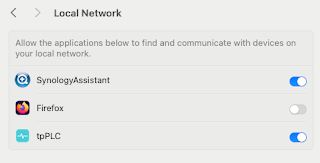
Note to self - Firefox and local connections

 Whilst trying to hit my NAS from Firefox on my Mac, I kept seeing errors such as:- Unable to connect Firefox can’t establish a connection t...