Sunday, 11 August 2013

Understanding HTTP plug-in failover in a clustered environment

Problem(Abstract)

After setting up the HTTP plug-in for load balancing in a clustered IBM® WebSphere® environment, the HTTP plug-in is not performing failover in a timely manner or at all when a cluster member becomes unavailable.

Cause

In most cases, the preceding behavior is observed because of a misunderstanding of how HTTP plug-in failover works or might be due to an improper configuration. Also, the type of Web server (multi-threaded versus single threaded) being used can affect this behaviour.

Friday, 9 August 2013

Deliver an exceptional mobile web experience using WebSphere Portal and IBM Worklight V6.0, Part 1: Integrating a hybrid mobile application with WebSphere Portal pages

Summary

IBM WebSphere Portal and IBM's Exceptional Web Experience solutions have been the market leader in web experience for more than a decade. IBM Worklight is a new, complete mobile enterprise application platform for delivering native, hybrid, and web applications. This article explains how WebSphere Portal and Worklight together enable enterprise users to provide multi-channel site support to their web communities. An exercise using IBM Worklight Developer Edition 6.0 to build a hybrid Android application for viewing WebSphere Portal pages is included.

Introduction

The mobile channel has become a critical and strategic channel for sales, marketing, and more for many – if not most industries. As businesses manage their company's brand through web sites, a common challenge has become how to deliver content and applications to mobile devices.

Before looking at the intersection of IBM WebSphere Portal and IBM Worklight, it's important to understand the difference between a website and an application:
  • A website aggregates web content and multiple web applications into a single user experience and works across multiple channels, including desktop browser, kiosk, smartphones, and tablets. A simple example might be your favorite airline's website. They probably have a mobile website, too, which supports phones and tablets. WebSphere Portal is the right platform for building a website.
  • A web application is custom-built and often targets specific tasks. For example, your favorite airline app from an app store that lets you book a flight or reserve a seat is an example of a web application. It usually contains a subset of the website's features, targeted to what you can practically do on the device. IBM WebSphere Application Server is the right option for delivering standalone web applications. IBM Worklight provides the ability to create both native and hybrid applications, and you can use either WebSphere Application Server as the back end (if you are creating hybrid apps), or WebSphere Portal as the back end (if you are creating hybrid websites).
The choices, then, come down to developing a native application, a hybrid application, or a web application. But there are two questions that need to be answered that will influence your mobile channel technology decision:
  • What devices will you need to support?
  • What is your application going to do?

Wednesday, 7 August 2013

IBM Business Monitor - Cluster Startup Order

Aide Memoire

Assuming that you're using the four cluster topology, the startup order is as follows: -
  • Messaging
  • Support
  • AppTarget
  • WebApp
The most crucial things are to: -

(a) Ensure that Messaging ( SI Bus / JMS ) is up before starting the AppTarget
(b) Ensure that Support, which hosts the Cognos BI application, is ALSO up before starting AppTarget

The reason for this is that the Monitor Models run on the AppTarget, and will "talk" back to the SI Bus(es) and also to Cognos.

BusinessSpace typically runs in the WebApp cluster, hence why it's the last to be started.

Nice :-)

Tuesday, 6 August 2013

Using the "Manage Profiles Interactive" tool to create new profiles in WebSphere Application Server

Problem(Abstract)

The Profile Management tool (PMT) GUI, used in creating new profiles, is not available for 64-bit systems. As a result, you must use the manageprofiles command-line tool shipped with WebSphere Application Server to create new profiles or augment existing ones. 

Cause

The manageprofiles.[sh|bat] script is very difficult to use and has many complex and confusing parameters.

The Manage Profiles Interactive tool uses your own systems environment to prompt you through the various required and optional parameters. After you are satisfied with your selections, the command is launched using the manageprofile.[sh|bat] creating the profile. This greatly increases the ease and speed in creating a new profile or augmenting an existing one.

Resolving the problem

The manageprofileInteractive.zip file (attached below) contains the executable manageprofilesInteractive.jar, and launch scripts run_manageprofileInteractive.bat and run_manageprofileInteractive.sh.

Using escape characters to construct a response file for the WAS Manage Profiles command

One of my colleagues asked how he could construct a response file the WAS Manage Profiles command ( manageprofiles.sh ) in order to allow him to enter a Distinguished Name ( DN ) for a personal SSL certificate containing one or more space characters e.g. cn=IBM GB, ou=IBM, o=GB.

The relevant parameter is: -

personalCertDN

It took me a while to work it out, but the WAS Information Center was of great use: -


which says: -

When you specify a single value that contains a comma character, such as the distinguished names for the personalCertDN and signingCertDN parameters, use a double-backslash before the comma character. For example, here is how to specify the personalCertDN value with a distinguished name:

signingCertDN=cn=testserver.ibm.com\\,ou=Root Certificate\\,  ou=testCell\\,ou=testNode01\\,o=IBM\\,c=US 

Here's my version: -

create
profileName=foobar1
nodeName=foobar1
hostName=rhel6.uk.ibm.com
cellName=snafu1
profilePath=/opt/IBM/WebSphere/AppServer/profiles/foobar1
templatePath=/opt/IBM/WebSphere/AppServer/profileTemplates/BPM/managed.procctr
federateLater=true
dbJDBCClasspath=/opt/IBM/WebSphere/AppServer/jdbcdrivers/DB2
dbType=DB2_DATASERVER
personalCertValidityPeriod=15
signingCertValidityPeriod=15
keyStorePassword=b0nf1re!
personalCertDN=cn=IBM GB\\, ou=IBM\\, o=GB
signingCertDN=cn=IBM GB\\, ou=IBM\\, o=GB

The Unix ( Linux in my case ) OS converts \\ to \ and the Java Virtual Machine ( manageprofiles uses Java under the covers ) uses the single \ character to "escape" the required space character.

Seemples …..

Monday, 5 August 2013

White Paper - Remove testing bottlenecks and test IBM® WebSphere MQ, TIBCO, Software AG webMethods, SOA, BPM, SOAP, REST and Cloud applications with IBM Rational test automation solutions

Virtualize unavailable applications and systems to test application performance and behavior earlier in the development lifecycle.

Companies all over the world are turning to IBM Rational to save millions of dollars on testing costs and accelerate the delivery of high quality software in complex application environments. Automate SOA and BPM testing with Rational Test Workbench, virtualize unavailable software and services with Rational Test Virtualization Server, and test SOA and BPM performance with Rational Performance Test Server.

The SOA ecosystem includes many types of technologies which are architected into business processes. IBM Rational test automation solutions offers rich integration with these technologies to provide native visibility into the entire process. At IBM, we know the differences in testing requirements associated with integration, BPM and governance platforms. IBM designs specific functionality and process into the solutions for each vendor to assure lifecycle coverage including unit, functional, integration, regression, performance, virtualized application and run time testing.

IBM has experience across all the major vendor technologies - IBM, TIBCO, Software AG webMethods, SAP, and more. If it's overall web services testing capabilities or a specific industry requirement you are looking for, we can just as easily help you with 70 technologies currently supported – industry specific protocols and the inclusion of what are often seen as "extras" as standard.

Sunday, 4 August 2013

Learn the Basics of ODM - An eBook from IBM

Operational Decision Management (ODM) is the evolution of business rules management. It provides a complete, easy-to-use system for automating day-to-day operational decisions that allows business people and IT to collaborate on business rules.

ODM not only allows you to automate your business rules. It enables you to detect real-time business events (such as a person making a credit card charge) and use rules to automate the appropriate response to those events.

Download this eBook to learn the basics of Operational Decision Management and whether it's right for your organization. In this useful guide, you'll also learn how to get started and what to look for in best-in-class ODM systems.

Table of Contents
• Chapter 1: What is Operational Decision Management?
• Chapter 2: Is ODM Right for You?
• Chapter 3: Looking Under ODM's Hood
• Chapter 4: The Life Cycle of Rules
• Chapter 5: Getting Started with ODM
• Chapter 6: Ten ODM Use Cases
• Chapter 7: Ten Characteristics of Best-in-Class ODM Systems

Click here to register for the free eBook.

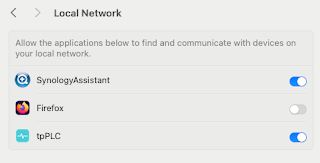
Note to self - Firefox and local connections

 Whilst trying to hit my NAS from Firefox on my Mac, I kept seeing errors such as:- Unable to connect Firefox can’t establish a connection t...