Thursday, 27 April 2023

IBM Container Registry - searching and formatting

 So, when querying images that have been pushed to a namespace within IBM Container Registry, one can format the output to only return certain columns such as repository (image) name and tag.

Who knew ?

Well, the authors of the documentation did, apparently :-)

Formatting and filtering the CLI output

For example: -

ibmcloud cr images --format "{{ .Repository }}:{{ .Tag }}"

icr.io/hello/hello_world:1.1

icr.io/hello/hello_world:1.2

icr.io/hello/hello_world:latest

etc.

Other examples, from the doc, include: -

ibmcloud cr image-list --format "{{ if gt .Size 1000000 }}{{ .Repository }}:{{ .Tag }} {{ .SecurityStatus.Status }}{{end}}"

ibmcloud cr image-digests --format '{{if not .Tags}}{{.Repository}}@{{.Digest}}{{end}}'

ibmcloud cr image-inspect ibmliberty --format "{{ .ContainerConfig.Labels }}"

etc.

Which is nice!

*UPDATE*

And, bringing two posts together, I can report the created date AND format it from Epoch time: -

ic cr images --format "{{ .Repository }}:{{ .Tag }}:{{ .Created }}" | awk 'BEGIN { FS = ":"} ; {$3 = strftime("%c", $3)} 1'

Friday, 21 April 2023

Today I Learned - Munging Epochs using awk

So today I had a requirement to convert some Epoch-formatted dates, located in a CSV file, into human-readable dates...

So today I learned about awk vs. gawk, and the strftime() function ...

I also learned that awk on macOS isn't the same as "real" Gnu awk ( aka gawk ), hence the need for gawk ...

I started by installing gawk: -

brew install gawk

and then updated my PATH to reflect it: -

PATH="/opt/homebrew/opt/gawk/libexec/gnubin:$PATH"

Using an example of my data: -

cat file.txt

1681486514
1681990787
1681992853
1681712949

which is WAY simpler than my real data, I was then able to munge it using awk ( or, really, gawk ) : -

awk 'BEGIN { FS = ","} ; {$1 = strftime("%c", $1)} 1' file.txt

which returns: -

Fri 14 Apr 16:35:14 2023
Thu 20 Apr 12:39:47 2023
Thu 20 Apr 13:14:13 2023
Mon 17 Apr 07:29:09 2023

I'd previously done much the same using Excel, via a formula: -

=F17/86400+DATE(1970,1,1)

where cell F17 contained the Epoch-formatted date

But scripts are so much more fun ...

Monday, 17 April 2023

IBM Cloud and JQ - more querying fun

 A colleague laid down a challenge - well, he didn't actually lay it down, he merely posted a single-line script that used awk and sed and grep - so I decided to build a better mousetrap ...

The requirement ... to query one's IBM Cloud account for Kubernetes (K8s) clusters, in this case leveraging the IBM Kubernetes Service (IKS) offering, and report the cluster name and the flavour ( flavor to our US friends )

Here is up with what I ended: -

for i in $(ic cs cluster ls --provider vpc-gen2 --output JSON | jq -r '.[].name'); do echo "Cluster Name:" $i; echo -n "Flavor: "; ic cs workers --cluster $i --output JSON | jq -r '.[].flavor'; done

which resulted in: -

Cluster Name: davehay-14042023

Flavor: bx2.4x16

Cluster Name: davehay-15042023

Flavor: bx2.4x16

In essence, I list the clusters in the account ( across all regions ), specifically those using the Virtual Private Cloud Generation 2 ( vpc-gen2 ) provider, grab and output the name, and then use the name to inspect the cluster and report on it's flavor ( sic ).

Rather than using awk and sed and grep etc. I chose to use jq, working on the assumption that all of our engineers will have that installed as it's a ubiquitous tool these days.

Tuesday, 4 April 2023

IBM Cloud CLI - Debugging

From this: -
we have some rather useful debugging env vars such as: -

- IBMCLOUD_API_KEY
- IBMCLOUD_TRACE
- IBMCLOUD_COLOR


etc.

TIL: FuzzyFinder - fzf - and jq

Today I learned ( well, actually it was yesterday but who's counting days ? ) about fzf in the context of using it to test JQ expressions.

The revelation came from Julia Evans, author of WizardZines, aka b0rk, about whom I've written before.

She'd mentioned the use of fzf and jq in a post on Mastodon: -


so I had to try it out ...

Install fzf

brew install fzf

Create a JSON document

cat << EOF > the_simpsons.json
[
    {
        "givenName": "Maggie",
        "familyName": "Simpson"
    },
    {
        "givenName": "Lisa",
        "familyName": "Simpson"
    },
    {
        "givenName": "Marge",
        "familyName": "Simpson"
    },
    {
        "givenName": "Homer",
        "familyName": "Simpson"
    },
    {
        "givenName": "Bart",
        "familyName": "Simpson"
    }
]
EOF

Fire up fzf

echo '' | fzf --preview 'jq {q} < the_simpsons.json'

Tinker with various jq queries


Nice!

Tuesday, 21 February 2023

Reading up on the differences between Zsh and Bash

Typically, when writing self-documenting scripts, especially those used during a demonstration, I'd add a command such as: -

read -p "Press [Enter] to continue"

However, using Zsh on macOS 13.2.1 Ventura, I saw: -

read: -p: no coprocess

If I skipped the -p I saw: -

zsh: not an identifier: Press [Enter] to continue

when I actually pressed the Enter key

As ever, the internet answered my cry for help

ZSH: Read command fails within bash function "read:1: -p: no coprocess"


So now I have this: -

ibmcloud cs cluster ls

read "?Press [Enter] to continue"

which rightly prompts: -

Press [Enter] to continue

Monday, 6 February 2023

Fun and games with Docker login on macOS

I've been around the houses with Docker Desktop, Podman and Docker via Homebrew on my Mac over the past few months

I saw something curious this morning, whilst trying to log into IBM Container Registry 

ic cr login

Logging 'docker' in to 'uk.icr.io'...

FAILED

Failed to 'docker login' to 'uk.icr.io' with error: Error saving credentials: error storing credentials - err: docker-credential-desktop resolves to executable in current directory (./docker-credential-desktop), out: ``

I then tried the same auth process using docker login 

docker login --username iamapikey uk.icr.io

but with the same effect: -

Password:

Error saving credentials: error storing credentials - err: docker-credential-desktop resolves to executable in current directory (./docker-credential-desktop), out: ``

In case I was missing something, I even tried the Docker Creds Helper: -

brew install docker-credential-helper

but to no avail.

Finally, in desperation, I nuked my Docker credentials file - which is a TERRIBLE thing imho 

rm ~/.docker/config.json

and tried again: -

docker login --username iamapikey uk.icr.io

Password:

Login Succeeded

Even better, now that I'd installed the creds helper - which caches the creds in the macOS Keychain, the config.json is somewhat cleaner: -

cat ~/.docker/config.json

{

"auths": {

"uk.icr.io": {}

},

"credsStore": "osxkeychain"

}

Better still, the IBM Cloud CLI is also happy: -

ic cr login

Logging 'docker' in to 'uk.icr.io'...

Logged in to 'uk.icr.io'.


OK


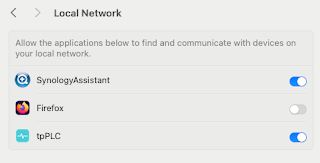
Note to self - Firefox and local connections

 Whilst trying to hit my NAS from Firefox on my Mac, I kept seeing errors such as:- Unable to connect Firefox can’t establish a connection t...