Thursday, 8 December 2011

Using Trust Association Interceptors with WebSphere Application Server to support OAuth tokens

I saw this on Twitter this morning, thanks to the @LotusEducation account which is ably run by Sonia Malik and Lorraine Ludwicki.

Summary:  Are you looking to share access of your protected resources by becoming an OAuth service provider? This article describes how you can use IBM® WebSphere® Application Server (V7.0 and later) with Trust Association Interceptors (TAI) to accept OAuth tokens for authorizing calls from applications or web sites (consumer) to protected resources. TAIs make it possible to support OAuth alongside other token services, such as LTPA, while meeting WS-Security restrictions. This content is part of the IBM WebSphere Developer Technical Journal.

Intoduction: OAuth (Open Authorization) is an open protocol that permits secure API authorization from desktop and web applications (consumers) by enabling the consumer to act on behalf of a user without requiring the user to provide sensitive account information, such as username and password.

An example of a consumer might be a company that wants to aggregate all of its customers' photos onto a single web page. Rather than asking every user to enter the username/password for each of their photo sharing accounts, the company can act as a consumer and each of the photo sharing web sites can act as service providers and exchange OAuth tokens. This gives the photo aggregator company access to a user's photos without the user potentially compromising the security of their account by giving out username/password information.

Wednesday, 7 December 2011

WebSphere Portal and IBM Web Content Manager - Search

Having blogged about Portal search in the past, and having had recent  discussions IBM Web Content Manager and Google Search Appliance integration with a colleague earlier, I found and shared these two links


Table of Contents
• 1 Search engine optimization
• 1.1 Overview of Search Engine Optimization
• 1.2 Definition of terms
• 1.3 How search engines work
• 1.4 More on Google
• 1.4.1 Google optimization basics
• 1.4.2 Other factors that will affect your ranking
• 1.4.3 Sitemaps
• 1.5 How Internet search engines work
• 1.6 Challenges with portal crawlability
• 1.7 Portal crawler awareness and normalized URLs
• 1.8 Sitemap portlet
• 1.9 External crawlability of Portal with WCM content
• 1.10 Web 2 0 and search
• 1.11 Case study using the sitemap portlet
• 1.11.1 Adding sitemap portlet to a page outside of the default navigation
• 1.11.2 Adding sitemap portlet to the theme
• 1.11.3 Configuring robots directives
• 1.11.4 Reconfiguring nrmalized URLs to include request parameters
• 2 Searching and crawling portal and other sites with portal search
• 2.1 Understanding portal search
• 2.2 Portal search architecture
• 2.3 Search services collections and scopes
• 2.4 Search and administration user interfaces
• 2.4.1 Search center
• 2.4.2 Search and browse
• 2.4.3 Suggested links
• 2.4.4 External links
• 2.4.5 Manage search
• 2.4.6 Portal Search Toolbox
• 2.4.7 WCM search component
• 2.5 Portal search APIs
• 2.6 Seedlist framework
• 2.7 Crawlability of portal with WCM content
• 2.8 Categorization and taxonomy
• 2.9 Case study crawling the portal and displaying search results
• 2.9.1 Suggested links
• 2.9.2 External search results


1 Basics of search engine functionality
2 Search services
3 Best practices
4 Conclusion
5 Resources
6 About the author

This is also worth a look

Monday, 5 December 2011

Resolution – 404 errors accessing WCM content through the POC Servlet (/wps/mypoc/…)

Am reposting this from Cody Burleson as it has a strong linkage to a project on which I was engaged earlier this year - in my case, we were using the Google Search Appliance to index WCM, in Cody's case, they were using IBM Omnifind.

Recently, we had a problem where WCM URLs in OmniFind search results (generated by the Portal seedlist mechanism) were giving 404 errors when clicked. These are URLs that contain /wps/mypoc in the URL. This page documents a solution that worked for us.

However, it's definitely worth a read ….

*UPDATE 03/01/2013 - Since I wrote this article in late 2011, Cody has removed the post from his blog. However, I've found what may be a new solution, and have blogged about it here: -

More on 404 errors accessing WCM content through the POC Servlet (/wps/mypoc/…) 

A surfeit of VMware and Linux goodies … including running VMware ESXi from a USB Key :-)

Whilst lurking around the blogroll on this very site, I noticed an interesting post from Graham Bucknell in IBM Australia. The title Unable to install VMware Tools – no such file or directory caught my eye, the content even more so, especially when he goes on to talk about: -

Now I use the very cool repo/unmanaged solution for the majority of our guests, since they run RHEL 6. If you don't know about this check it out here. If you use RHEL kickstart, it is trivial to make new guests come out with tools installed and the tools repo enabled. Anyway, enough gushing, just check it out if you use RHEL on VMware.

and: -

I should note before getting into this, that I am running ESXi from a USB key.

both of which look (a) sweet and (b) interesting.

I shall now go and read a bit more …..

Michael Sampson - Collaboration Roadmap: You've Got the Technology — Now What?

Having thoroughly enjoyed Michael's earlier book: -


User Adoption Strategies: Shifting Second Wave People to New Collaboration Technology when it came out last year ( thanks to ThisWeekInLotus from whom I received it as a prize !! ), I'm going to be putting in an order for Michael's latest book: -


Many firms are struggling with collaboration technology. Either it's been installed and is not being used, or they are not sure what to do. How do you make great decisions about collaboration technology and its use within organizations?

Collaboration Roadmap answers both questions.

- Introduction and Overview
- Foreword - by Ed Brill (IBM Corporation)
- Chapter 1. Setting the Scene
- Chapter 2. Really Understand the Technology
- Chapter 3. Outline the Vision
- Chapter 4. Accept Technology is a Small Factor in Success
- Chapter 5. Determine Your Governance Approach
- Chapter 6. Make Every Effort to Engage the Business
- Chapter 7. Apply Intentional Energy to Adoption
- Chapter 8. Pursue Increasing Value
- Chapter 9. Your Collaboration Journey
- Appendix 1. Collaboration Theory

Collaboration Roadmap packs 15 years of experience into 320 pages.

If you or your organisation are looking at collaboration technology, or considering its implementation, it's definitely worth a look.

PS Just to remind you, "...The postings on this site are my own and don't necessarily represent IBM's positions, strategies or opinions. My blog is PERSONAL…."

Using packet trace tools iptrace, snoop, tcpdump, wireshark, and nettl

Saw this Technote float by my Twitter river of news this morning, kindly tweeted by the IBM_AppServer account

It was ostensibly writing for WebSphere Edge Server, but is going to be relevant to many other use cases as well.

In essence, it provides a very brief description of the monitoring tools available on various flavours of Unix … oh, and Windows as well.

Well worth bookmarking, it may just save your life project.

It also allows you to feel like a character from the Matrix film, although don't start using nmap at work, kids, unless you know precisely what you're doing :-)


Friday, 25 November 2011

I  Lotus on my iPhone :-)

Just downloaded three new apps for my shiny new iPhone


I also noticed that the Connections app now supports WordPerfect documents via their app - which is nice - I'm sure that someone on Twitter mentioned a need for WP on the iPad or iPhone recently ?

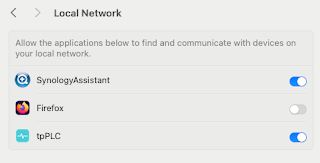
Note to self - Firefox and local connections

 Whilst trying to hit my NAS from Firefox on my Mac, I kept seeing errors such as:- Unable to connect Firefox can’t establish a connection t...